
Here’s the short version before we dive deep: the TickType QK60 HE is QwertyKeys’ first-ever magnetic (Hall effect) keyboard — and it answers two questions that have haunted the entire category. First, can a legendary custom-keyboard maker preserve its build quality when switching from mechanical to magnetic switches? Second, can a Hall effect keyboard actually sound HiFi? Let’s unpack both, across five dimensions: build, feel, sound, performance, and software.
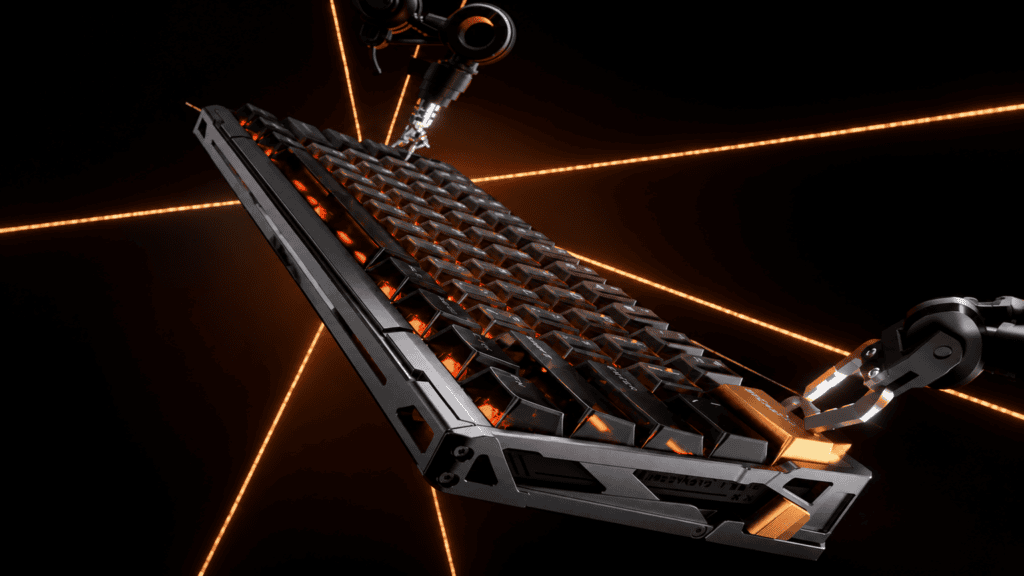
Introduction: A Custom-Keyboard Veteran’s Hall Effect Debut
QwertyKeys needs little introduction in the custom keyboard world. From the QK65 to the QK60, its aluminum craftsmanship and gasket-mounted typing feel have been the “gateway drug” for countless enthusiasts.
But the Hall effect arena is a different game entirely. The structural logic, feel tuning, and sound control of magnetic switches follow completely different rules than custom mechanical switches.
The TickType QK60 HE — designed by QwertyKeys and sold/supported domestically through TickType — is QK’s first magnetic keyboard. So the real question is: Can it hold the line on QK’s signature quality and feel? And can a Hall effect board truly go HiFi?
Build Quality: 6063 Aluminum + 220-Grit Anodizing
Let’s start with the foundation — because this is where QK’s reputation lives or dies.
Materials & Craftsmanship
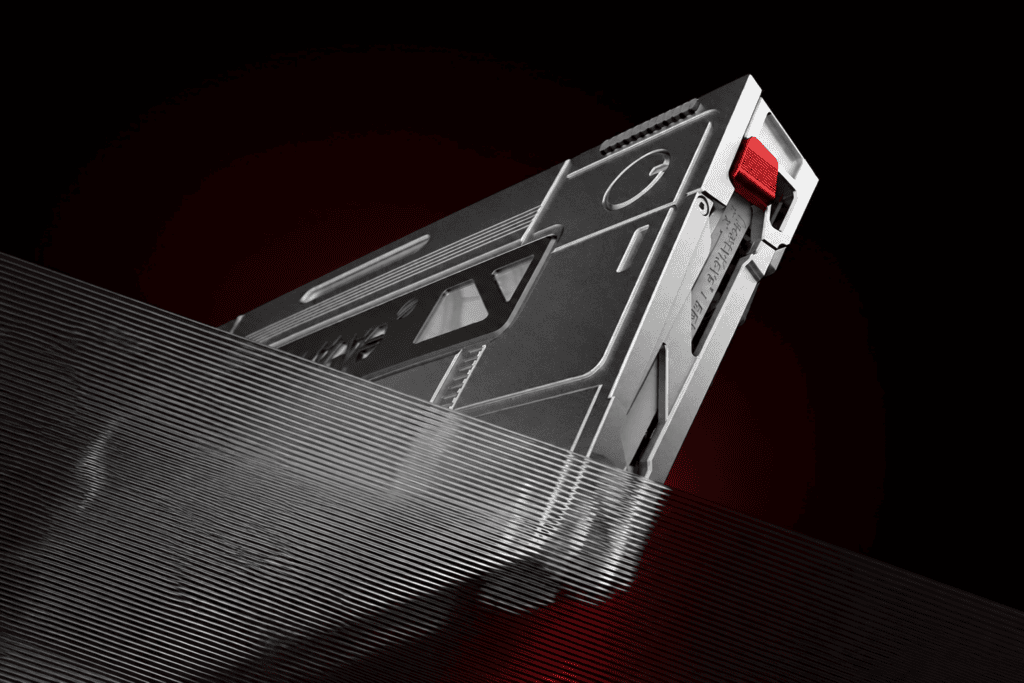
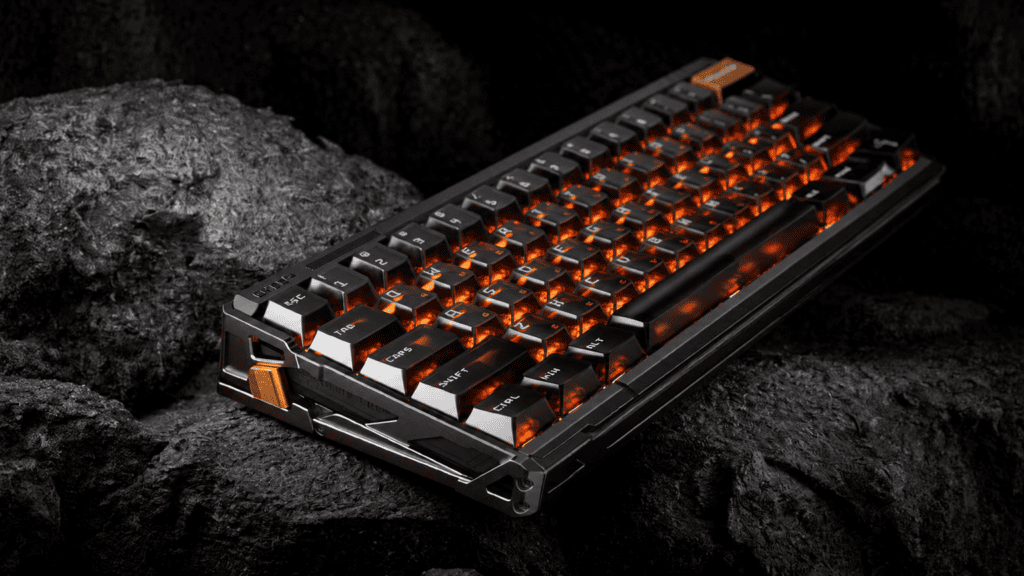
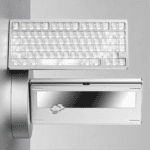
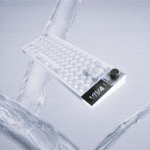
The TickType QK60 HE uses a full 6063 aluminum body with 220-grit anodized finishing — QK’s classic recipe. First impressions are blunt and glowing: “The anodizing feel absolutely doesn’t disappoint — I almost thought it was titanium.”
That 220-grit blasting delivers a surface refinement that sits in the upper tier of aluminum keyboards. Batch-to-batch anodizing consistency has always been a QK strength, and it remains one of the core advantages custom brands hold over mass-market manufacturers.
Design Language: Cyber-Styled Cutouts & Contrast
Some users initially disliked the “cutouts plus contrasting elements” aesthetic — until the unit arrived. The verdict flipped completely: “This keyboard is just cool!”
The side profile has been described as “sexy,” a design language that has almost no competition among mass-produced magnetic keyboards. Even the feet use a custom-tooled design, with the shock-absorbing structure visible from the front.
One Detail to Note
A few users reported the top-left badge sits slightly high, making it easy to mis-hit the ESC key — “the ESC and a few neighboring keys are easy to fat-finger until you adjust.” Not a dealbreaker, but worth knowing before you buy.
Typing Feel: What Does the Beryllium Copper Leaf Spring Bring?
This is the heart of the review — the standout engineering choice on the TickType QK60 HE.
Beryllium Copper Leaf Spring vs. Traditional Gasket
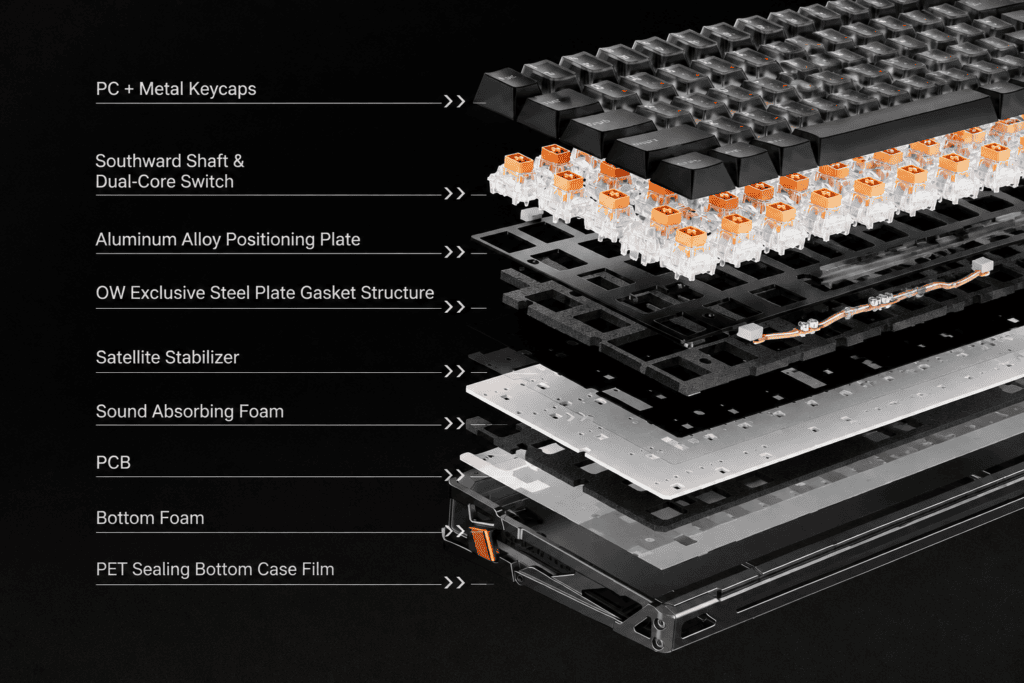
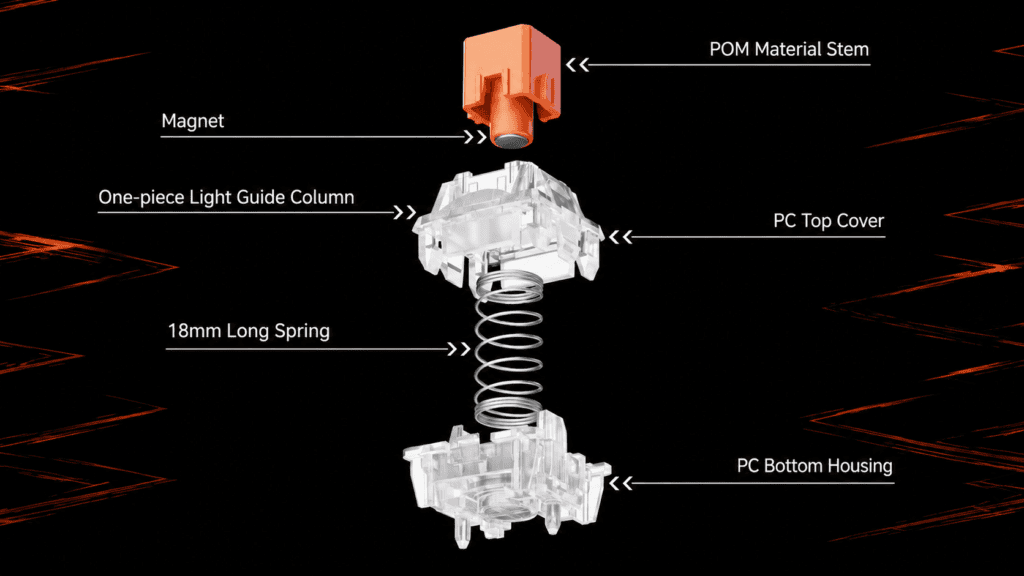
The QK60 HE uses OW’s exclusive patented beryllium copper leaf spring gasket structure, building a precise elastic support system at the key trigger and rebound points.
The core difference versus traditional poron-strip gaskets: beryllium copper has a far higher elastic modulus than foam, offering better force consistency — and it won’t collapse from long-term compression. The official positioning is clear: “to solve the industry pain points of loose feel and noisy sound at the root — letting Hall effect keyboards go HiFi too.”
The Actual Feel: “Completely Different” from Past QK Boards
Here’s what matters most. Even though it still uses a beryllium copper leaf spring gasket, the feel is completely different from QK’s usual pursuit of ultra-soft bounce.
Even with the bottom foam removed, the bottom-out feel stays crisp and clean — and the sound is no longer the old muted-and-wet signature, but rather “muted yet crisp.” In other words, the QK60 HE’s feel is tuned for snappy decisiveness, not the soft, cushioned bounce of QK’s mechanical lineup.
If you’re coming from a QK65 or QK60 mechanical board, set your expectations: this is a different animal.
The Ceiling of Magnetic Feel
Physics sets the limit here. Without metal contacts, there’s no tactile bump — linear feel is simply innate to Hall effect switches. Within that constraint, the QK60 HE pushes the feel to “crisp without being harsh” through its leaf spring plus refined internal fill.
Sound: Can a Hall Effect Keyboard Go HiFi?
This section answers the headline question directly.
The “Original Sin” of Magnetic Switch Sound
Magnetic keyboards have a long-standing sound problem. One honest community question captured it perfectly: “Does anyone else think magnetic keyboards sound weird?” — with the conclusion being “kind of like mahjong tiles, a bit loud and a bit odd.”
There’s no metallic contact click, but the hollow structure easily produces cavity resonance and loose noise. This is a category-wide issue — not unique to QK.
How the QK60 HE Sounds
Reviewers describe it as “muted yet crisp.” The “muted” comes from fill suppressing cavity noise; the “crisp” comes from the rigid leaf spring support and the magnetic switch’s bottom-out character.
QK tackles the noise with a multi-layer stereo sound-dampening architecture — sandwich foam + switch pad + sound-tuning pad + bottom foam. One reviewer summed it up: “it lets Hall effect go HiFi too.”
But “HiFi” Is Relative
In the magnetic category, the TickType QK60 HE sits firmly in the first tier — clean, non-hollow, no obvious noise. But against a thick mechanical build, physics still caps the acoustic depth it can reproduce.
The honest answer: magnetic keyboards can go HiFi — but the HiFi ceiling differs from mechanical.
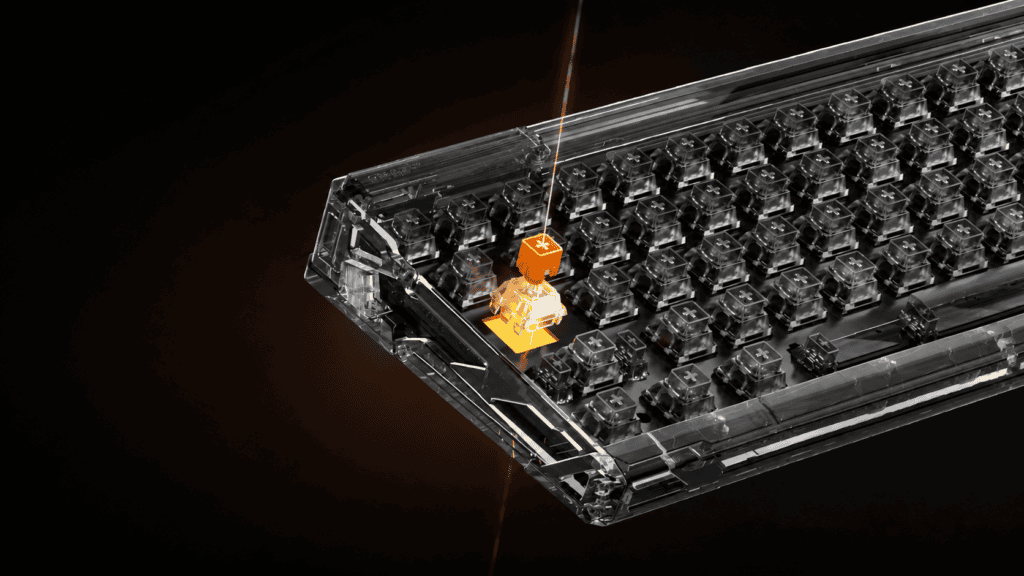
Performance: 0.001mm RT + 0.06ms Latency + 800Gs Flux
Now for the numbers that matter to gamers.
Core Specs at a Glance
| Spec | Rating |
|---|---|
| RT Precision | 0.001mm full-range |
| Latency | 0.06ms |
| Polling Rate | 8000Hz |
| Max Magnetic Flux | 800Gs |
| Chip Architecture | In-house triple-chip (1 master + 2 slave) |
What 0.06ms Latency Actually Means
A 0.06ms latency is top-tier for magnetic keyboards — compared to the mainstream 0.1–0.5ms, the QK60 HE sits in an absolute first tier. In Valorant and CS2 counter-strafing, release latency directly affects how “clean” your stop is. At 0.06ms, the moment you lift the key, the “stop” signal reaches your PC almost instantly.
The Real Impact of 800Gs Flux
Common magnetic keyboards run around 500Gs; the production TickType QK60 HE ships with an in-house switch hitting 800Gs — nearly double. Stronger, more stable flux means better trigger consistency: no more “some keys fire at a feather touch while others need a deep press.”
Triple-Chip Architecture: Redundant Stability
The QK60 HE runs an in-house triple-chip design — one master MCU driving two slave MCUs (one for matrix scanning, one for lighting). The payoff is redundant stability: even during a slave’s momentary load spike, the others keep working — no dropped frames or misfires.
Software & Driver: Web-Based Convenience and Its Gaps
Here’s where a custom brand enters “rookie territory” for Hall effect.
Web Driver: Plug and Play
The TickType QK60 HE supports a web-based driver — no client install needed, with real-time lighting preview. Coverage includes: RT sensitivity, trigger travel, lighting customization, and music-reactive effects.
Music Reactivity: Fun but Unfinished
Users call the music-reactive feature “refreshing” — you can tune high, mid, and low frequency sensitivity separately. But there’s a clear shortcoming: without a desktop client, keeping it running means keeping the browser tab open — close the tab and it resets to the default lighting.
Another quirk: re-plugging the cable (even on the same device) resets the lighting to “on,” and switching the left-side menu repeatedly in the web app can also re-enable it.
The Custom Brand’s Software Gap
On mechanical boards, QK offers deep customization via VIA. On magnetic drivers, it’s still a newcomer. The web driver is functionally decent, but the lack of a persistent desktop client is exactly the area where custom brands must catch up to mass-market players.
Verdict: Can Custom DNA Carry a Hall Effect Board?
Let’s return to where we started and deliver the final call.
What the TickType QK60 HE Nails
- Build: 6063 aluminum + 220-grit anodizing — QK’s craftsmanship, uncompromised.
- Feel: The beryllium copper leaf spring delivers a completely different, crisp feel — solid bottom-out, excellent consistency.
- Sound: First-tier in the magnetic category — “muted yet crisp” is a genuine vindication.
- Performance: 0.001mm RT + 0.06ms latency + 800Gs flux + triple-chip = flagship-grade specs.
- Custom playability: Compatible with the Wooting 60 PCB — the case itself is an “upgrade ticket.”
Where It Falls Short
- Immature driver ecosystem: No desktop client, advanced lighting won’t persist, cable re-plug resets lighting.
- Stabilizer tuning: Magnetic large-key consistency remains an industry-wide weak spot the QK60 HE hasn’t fully solved.
- Feel breaks from QK tradition: If you came for the signature soft bounce, you may be disappointed.
The Final Call
The TickType QK60 HE proves what custom DNA brings to Hall effect: finer build, more considered structure, cleaner sound. It also exposes the custom camp’s weak spots — driver maturity and software completeness that mass-market brands have spent years refining.
So, can a Hall effect keyboard go HiFi? Yes — with conditions. The QK60 HE achieves HiFi-grade sound and feel within the category, provided you accept magnetic switches’ physical limits and the web driver’s functional compromises.
- If you’re here for custom-grade quality: the TickType QK60 HE won’t let you down.
- If you’re here for a Wooting-level software ecosystem: it still needs time.
 English
  German
  Portuguese
  Spanish
  Italian
  Finnish
  French
  Japanese
  Korean
  Swedish