
Regardez n'importe quel professionnel Valorant ou CS2 Si vous assistez à un match aujourd'hui, vous remarquerez quelque chose d'assez étrange : aucun clavier de taille standard n'est visible. À la place, chaque joueur dispose d'un clavier compact 60% ou 65%, fortement incliné vers la gauche, avec un immense tapis de souris occupant toute la partie droite du bureau.
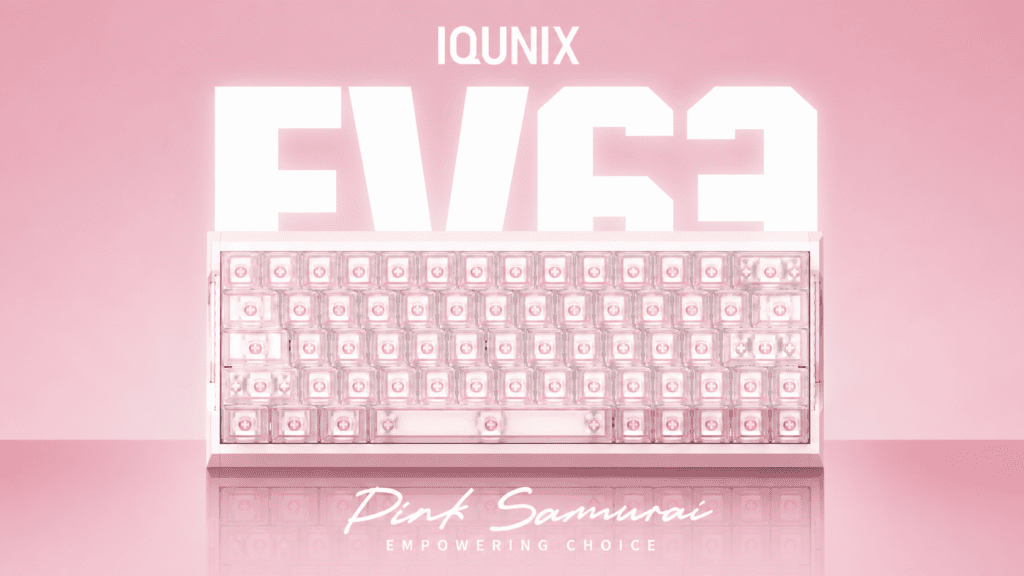
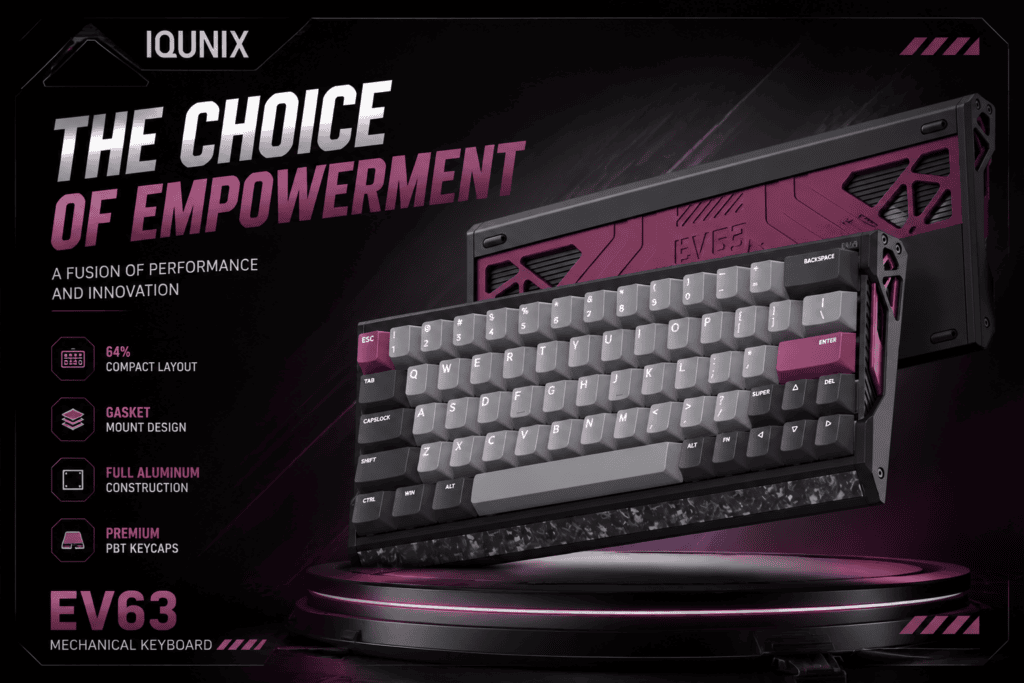
Ce n’est pas un hasard. C’est une révolution discrète qui se déroule sur la scène compétitive, et elle soulève une question majeure : Pourquoi les joueurs professionnels abandonnent-ils les claviers de taille standard ? La réponse tient en trois mots : espace, vitesse et stabilité. Et le Clavier de jeu à effet Hall IQUNIX EV63, Avec sa disposition à 63 touches spécialement conçue à cet effet, il s'avère être l'incarnation parfaite de cette tendance.
Voyons pourquoi.
Partie 1 : L’espace — Le péché originel des claviers pleine taille
Pour comprendre ce changement, il faut d'abord comprendre comment se déplacent réellement les joueurs professionnels de FPS.
Les compétiteurs d'élite des FPS courent sensibilité de la souris extrêmement faible — si bas qu'un simple demi-tour peut nécessiter de balayer presque tout le bureau avec la souris. Viser avec précision ne se résume pas à un mouvement du poignet ; c'est un mouvement complet du bras. Cela signifie qu'une chose compte avant tout : immobilier.
C’est là que le clavier pleine taille devient un inconvénient :
- Le pavé numérique Sur un clavier de taille standard, le coin inférieur droit se trouve directement sur la trajectoire de la souris d'un joueur droitier. Lors d'un duel intense, un mouvement brusque et saccadé peut projeter la souris contre ce coin inférieur droit, interrompant ainsi le tir en plein mouvement.
- Les tests ont montré que passer d'une taille standard à une taille standard Un clavier à 87 touches libère environ 30% d'espace sur le bureau, augmentant ainsi la portée de déplacement de la souris d'environ 15 cm.
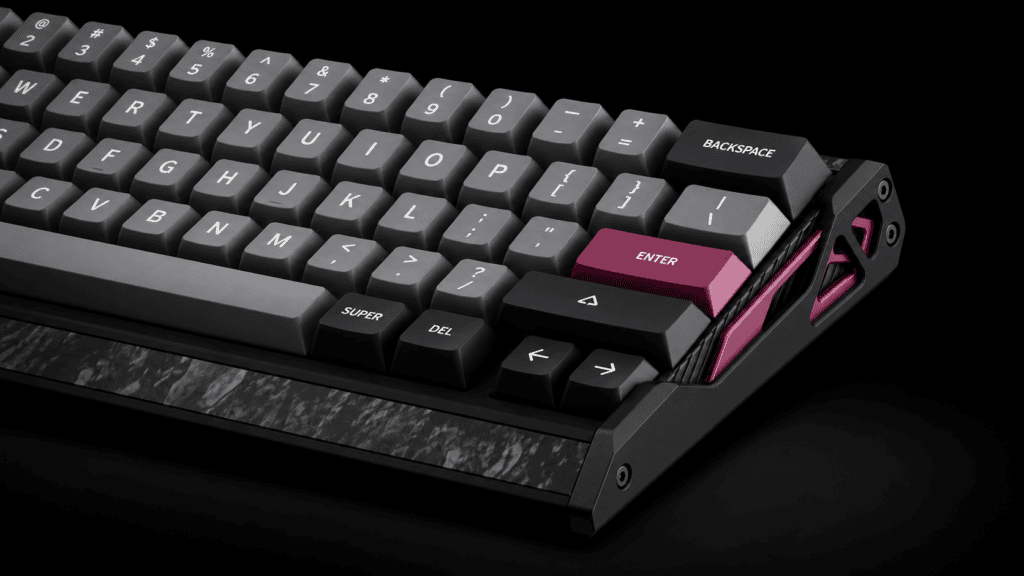
L'intérêt principal d'une configuration 60% réside précisément en ceci : Supprimez toutes les touches inutiles au jeu et rendez cet espace à la souris. La disposition à 63 touches de l'EV63 (commercialisé officiellement sous la référence 60%) fait exactement cela — tout en étant intelligemment conserver les touches fléchées dédiées — et réduit l'encombrement au maximum. La carte entière mesure seulement 300,9 mm de large et pèse 1206 g.
La conclusion est simple : les configurations 60% ne sont pas une esthétique de niche, elles deviennent la norme dans le secteur concurrentiel.
Partie 2 : Vitesse — 63 touches, conçues pour une réponse plus rapide
L'espace n'est que la première étape. La deuxième raison pour laquelle les pros délaissent les planches de taille standard est que… Conception compacte et performances optimales : une alliance naturelle.
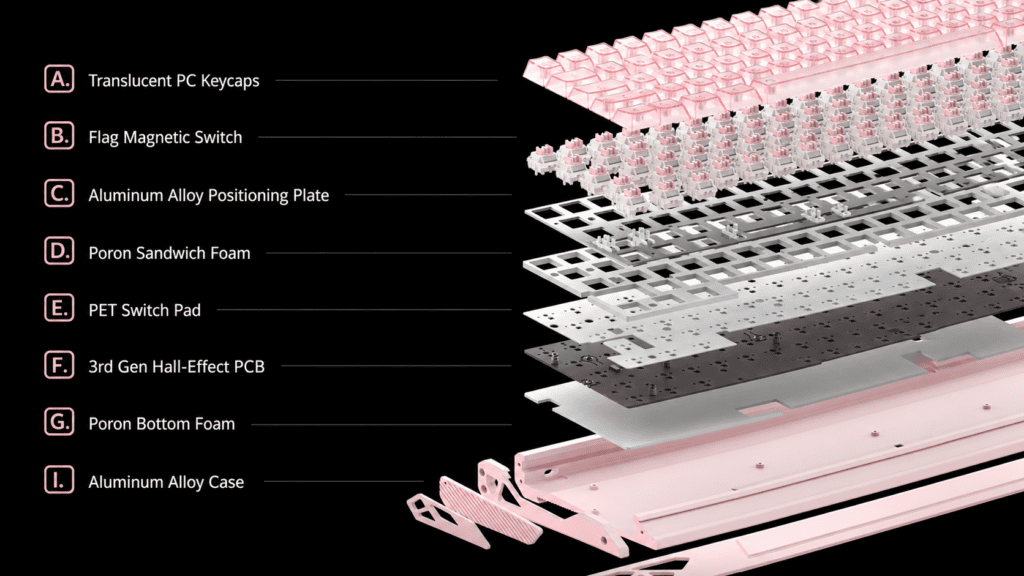
Le IQUNIX EV63 Elle est conçue selon une fiche technique qui ressemble à la liste de souhaits d'un professionnel :
- Fréquence d'interrogation de 8 kHz + Latence ultra-faible de 0,125 ms
- Capteurs à effet Hall de troisième génération, avec un 400% plage de tension utilisable plus étendue pour une résolution de signal plus élevée
- Propriétaire Mystery X Axis Ultra des commutateurs, délivrant un flux magnétique de fond de 780 GS — la plaçant ainsi au sommet du secteur
- Déclenchement rapide de précision sur toute la course, au 0,01 mm, réglable jusqu'à 0,001 mm
Pourquoi les petits écrans sont plus performants en matière de latence
Ce partenariat repose sur une véritable ingénierie. Les configurations 60%–75% sont devenues le principal support de la technologie des commutateurs magnétiques (à effet Hall). — et ce n'est pas un hasard. Des circuits plus courts et des structures internes plus légères facilitent naturellement la réalisation de cet objectif. latence inférieure à 0,1 ms. Les cartes de taille standard, avec leurs circuits plus longs et leur routage de signaux plus complexe, n'offrent tout simplement aucun avantage en matière de réactivité brute.
Les critiques ont confirmé ces observations dans la pratique, notant que l'EV63 “ A obtenu les meilleures notes pour sa rapidité et sa constance de réponse. ” Lors de tests FPS réels, son déclencheur de contre-strafe — le moment décisif pour réussir un tir après un arrêt — s'est avéré à la fois rapide et fiable.
Partie 3 : Stabilité — Rapide, mais jamais “ flottante ”
La vitesse ne vaut rien sans contrôle. Un clavier qui réagit instantanément mais de manière irrégulière est un handicap ; c’est la troisième raison pour laquelle les professionnels font confiance à l’EV63.
Deux technologies fondamentales assurent sa stabilité :
Algorithme MAT™ 2.0
la technologie exclusive d'IQUNIX MAT 2.0 Il calibre chaque touche en temps réel, chaque clavier étant réglé individuellement avant sa sortie d'usine. Lors de longues sessions intensives, l'algorithme stabilise dynamiquement les performances — si bien que le dernier round d'un match marathon est identique au premier.
Système d'alimentation indépendant à double circuit
Voici le héros discret de ce design. L'EV63 sépare complètement l'alimentation électrique du rétroéclairage de celle des capteurs à effet Hall.
Sur un clavier traditionnel, l'éclairage et les capteurs partagent le même circuit. Si l'on pousse l'éclairage RGB à pleine luminosité, les fluctuations de tension qui en résultent peuvent provoquer des dysfonctionnements. entrées manquées ou faux déclenchements. L'architecture à double circuit de l'EV63 élimine ce problème à la source.
Comme le résume succinctement un article de critique : “ Grâce à son algorithme MAT 2.0 et à sa conception d'alimentation indépendante à double circuit, l'EV63 affiche une stabilité nettement supérieure sous charge élevée prolongée, sans dérive de tension ni déclenchement intempestif observés. ”
Partie 4 : Les pros ont voté — et les données sont formelles
Les paroles sont faciles, alors regardons les faits.
Selon ProSettings.net, l'EV63 est déjà utilisée en compétition — avec 6 joueurs professionnels répertorié comme exécutant le IQUNIX EV63 lors de vrais matchs.
Mais voici la caractéristique qui comble véritablement l'écart entre amateurs et professionnels : le logiciel de pilotage de l'EV63 est livré avec préréglages de configuration intégrés de professionnels CS2 et Valorant joueurs.
Cela signifie que vous pouvez appliquer les réglages exacts d'un professionnel (points d'activation, sensibilité du déclencheur rapide, etc.) en un seul clic. Plus besoin de passer des semaines à tâtonner pour trouver la configuration optimale. Les pros l'ont déjà réglé pour vous.
Conclusion : De “ complet ” à “ ciblé ”
Le clavier pleine taille représente complétude Elle a tout, et elle peut tout faire. Mais ce n'est pas ce dont un concurrent a besoin.
Les joueurs professionnels ont besoin se concentrerNe gardez que l'essentiel et éliminez le reste. C'est toute la philosophie des 63 touches de l'EV63 : chacune d'elles a sa raison d'être.
Il ne s'agit pas d'une soustraction. C'est la précision.
Et c'est précisément pourquoi IQUNIX EV63 a acquis sa réputation de “ arme ultime ” — non pas parce qu'elle possède le plus, mais parce qu'elle fait mieux que quiconque ce qui compte le plus.
 English
  German
  Portuguese
  Spanish
  Italian
  Finnish
  French
  Japanese
  Korean
  Swedish