
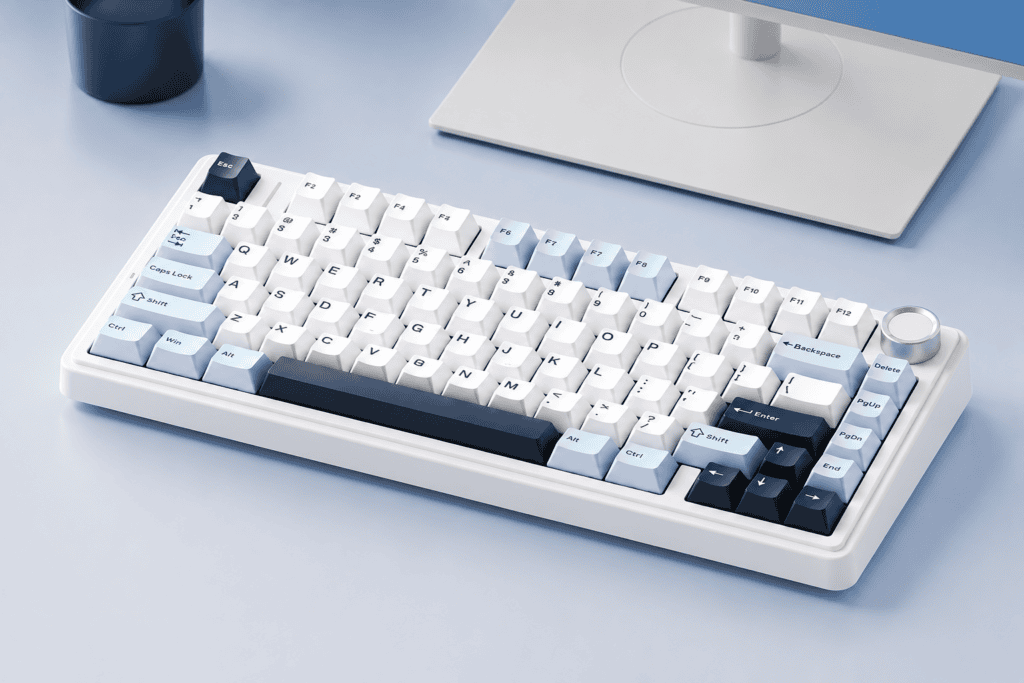
If you are currently using the AULA F75, you might be asking yourself: Is it not good enough? Of course not—the F75 is already a standout mechanical keyboard in its price tier. But if you ask, “Can my setup be even better?” The answer is a resounding yes.
The AULA F75 and the AULA AG75 are siblings from the same brand, sharing the highly popular 75% layout and excellent build quality. However, their underlying logic is entirely different. The F75 represents the pinnacle of traditional mechanical keyboards, focusing on the ultimate “feel” and “sound.” Meanwhile, the AG75 represents the new generation of Hall Effect magnetic keyboards, pursuing the absolute physical limits of “speed” and “programmability.”
What exactly do you get when you upgrade from the F75 to the AG75? Let’s break it down across 5 key dimensions.
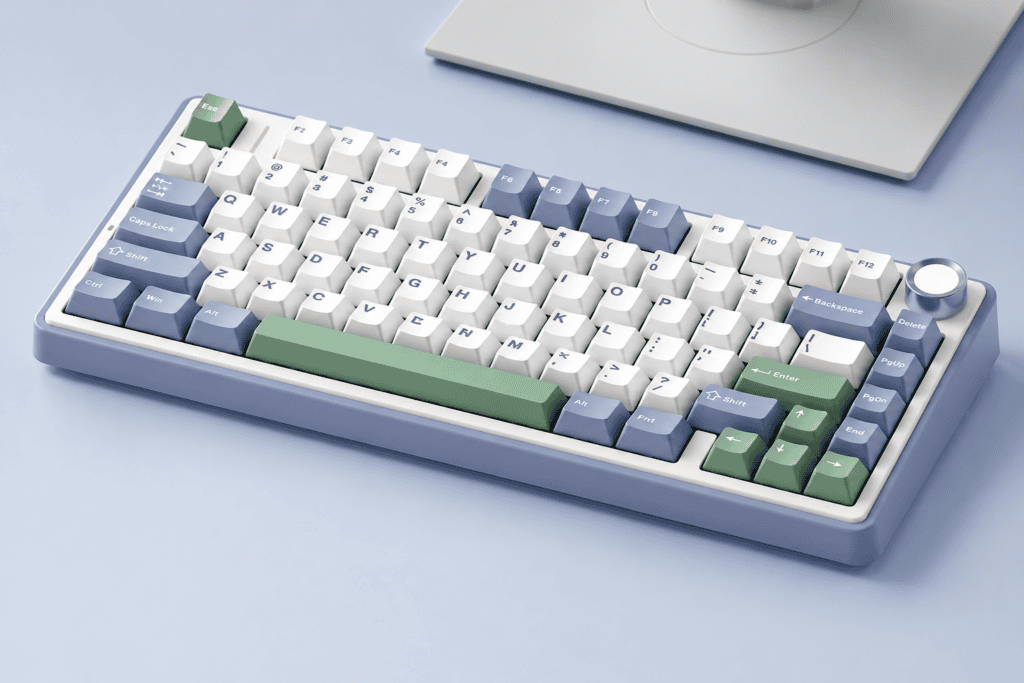
Part 1: Speed — From “Fast Enough” to “Physical Limits”
The F75’s 1000Hz polling rate is already fast, but the AG75’s 8000Hz is eight times faster. This isn’t just the difference between “sufficient” and “better”—it is a breakthrough of physical limits.
AULA F75 Configuration:
- Provides a 1000Hz polling rate in 2.4GHz wireless mode with zero-delay wired connection.
- Traditional mechanical switches rely on physical metal contacts, which inherently require a 5–20ms debounce delay.
- For the vast majority of casual gamers, this is more than fast enough.
AULA AG75 Leap:
- Boasts an Frecuencia de sondeo de 8000 Hz, bringing average latency down to a staggering 0,08 ms (Ultra version).
- Utilizes 4th-generation Hall Effect sensors for non-contact triggering, completely eliminating physical debounce delay.
- Features a key scanning rate of up to 256kHz.
- Overall, the speed is 5 to 8 times faster than the F75.
Scenario Comparison:
- F75: When you counter-strafe in Valorant, the signal takes about 4ms to travel from the switch to your PC.
- AG75: That exact same action takes only 0.08ms—a 50x difference in responsiveness.
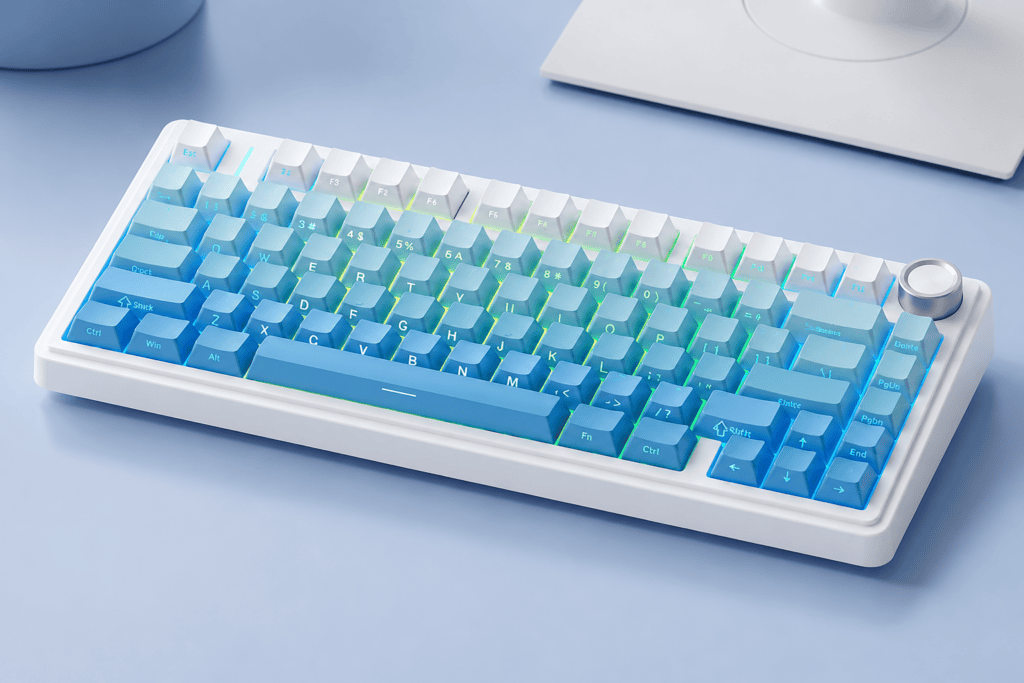
Part 2: Precision — From “Fixed Actuation” to “Micron-Level Adjustability”
With the F75, the actuation point is dictated by the physical structure of the switch; if you want a different feel, you have to swap the switches. With the AG75, every single key can be independently tuned down to the 0.001mm level.
AULA F75 Configuration:
- Supports full-key hot-swappability, compatible with almost all 3-pin and 5-pin mechanical switches on the market.
- However, the actuation point is fixed (e.g., standard red switches actuate at ~2.0mm).
- The customization lies in physically swapping switches, not adjusting them.
AULA AG75 Leap:
- Adjustable actuation range from 0.001mm to 3.4mm.
- Rapid Trigger (RT) precision reaches 0.001mm (and can even be tweaked to 0.0001mm).
- Per-key customization: Set your WASD keys to an ultra-fast 0.1mm for gaming, and your typing keys to 2.0mm to prevent typos.
- Offers four custom magnetic switch options: Mixue (Linear), Bingxin Silver (Tactile), Chaoshen (Ultra-fast Linear), and Babao (Crisp “water drop” sound).
Scenario Comparison:
- F75: Want to change your actuation? You need a switch puller, new switches, and 30 minutes of physical labor.
- AG75: Open the web driver, drag a slider, and your key is perfectly tuned in 3 seconds.
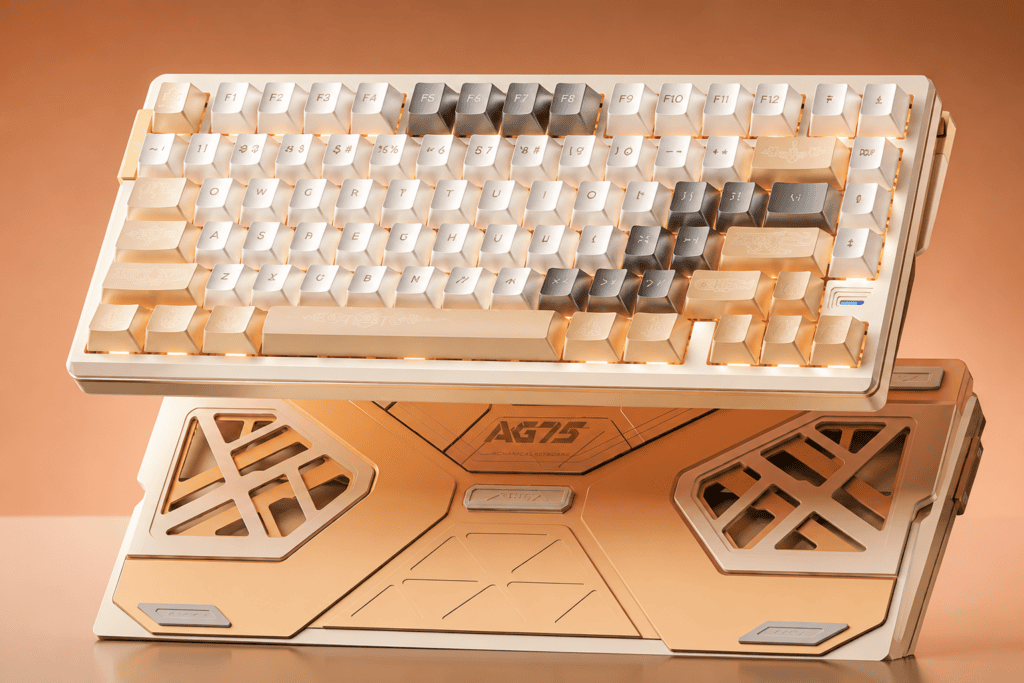
Part 3: Rapid Trigger — The Feature F75 Can Never Achieve
Rapid Trigger (RT) is the killer feature of magnetic keyboards. Due to physical limitations, traditional mechanical keyboards like the F75 simply cannot achieve this.
Why can’t the F75 do it? Traditional mechanical switches rely on metal leaves making physical contact. To register a second keystroke, the key must travel back up past a fixed reset point. This creates a “reset dead zone” dictated by the physical hardware, which software cannot bypass.
What does the AG75’s Rapid Trigger do? The AG75 eliminates the reset dead zone entirely. The key resets the instant you lift your finger and triggers the instant you press down again.
- RT precision of 0.001mm with an adjustment range of 0.001–3.4mm.
- This is absolutely crucial for counter-strafing in FPS games—the faster you stop, the more accurate your shots.
Scenario Comparison:
- F75: In CS2, you must let the key lift a specific physical distance before you can press it again to register a stop. That distance is your “dead zone time.”
- AG75: Rapid Trigger allows the key to reset after just 0.001mm of upward travel. The dead zone is virtually zero.
Part 4: Acoustics and Feel — Different Kinds of “Good”
Both keyboards sound incredible, but they achieve their acoustics in entirely different ways. One is the ultimate “muted thock,” while the other pursues pure “HiFi clarity.”
AULA F75 Acoustics:
- Features a Gasket mount structure with a 1.2mm single-key flex-cut PCB for a softer, bouncier typing feel.
- 5-Layer Sound Absorption: Silicone base pad, Poron bottom foam, PET sound enhancement pad, IXPE switch pad, and Poron plate foam.
- Goal: To eliminate all ping and hollow sounds, delivering a concentrated, quiet, and deeply satisfying “thocky” sound.
AULA AG75 Acoustics:
- Cuenta con una calidad superior Full CNC Aluminum body (treated with 220-mesh anodizing or electrophoresis).
- 6-Layer Full Filling System: Slow-rebound PO foam, PET pads, and a carbon fiber positioning plate.
- Goal: HiFi-level pure audio quality—clean, crisp, and richly layered.
Scenario Comparison:
- F75: Feels like a top-tier soundproofed studio—quiet, pure, and free of any unwanted noise.
- AG75: Feels like a high-end HiFi audio system—every single acoustic detail is meticulously tuned and resonant.
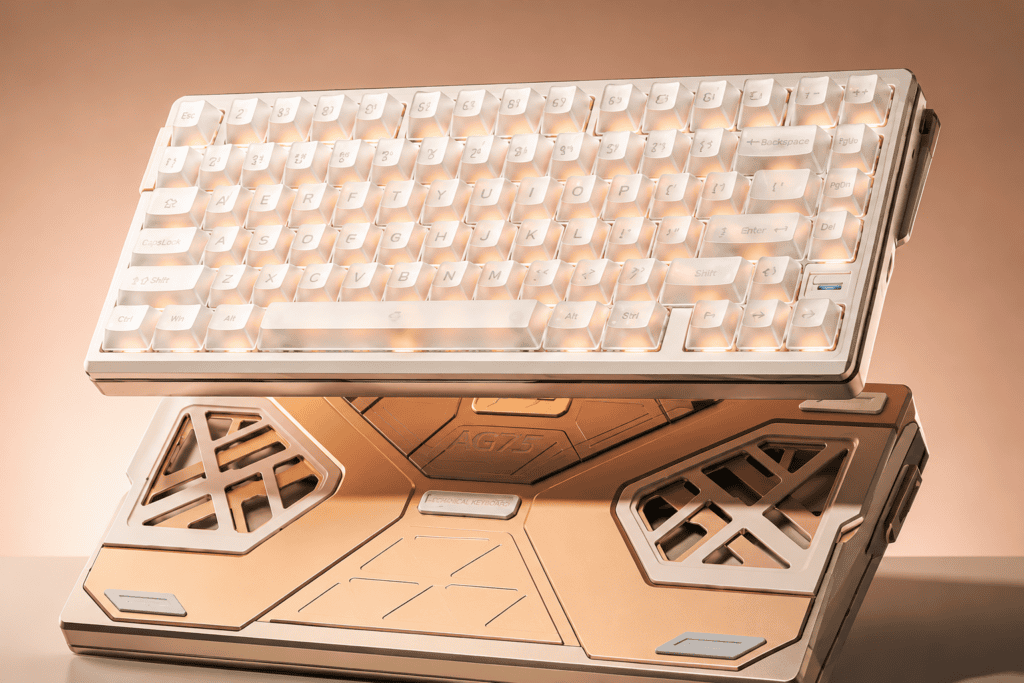
Part 5: Versatility & Scenarios — From “Sufficient” to “Omnipotent”
The F75 is a “great keyboard.” The AG75 is a keyboard that “can become whatever you need it to be.”
AULA F75 Versatility:
- Tri-mode wireless (Bluetooth 5.0 / 2.4GHz / Wired), capable of connecting to 5 devices simultaneously.
- Massive battery life lasting weeks.
- Multimedia knob, PBT keycaps, and full hot-swappability.
- Ideal para: Office work, heavy typing, and casual gaming. It’s the ultimate all-rounder.
AULA AG75 Versatility:
- Desarrollado por AULA Web Driver 3.0—tune everything directly in your browser without downloading bloatware.
- Supports advanced RT/SOCD settings and one-click imports of pro-player configurations.
- Quick-release magnetic structure for easy modding.
- 170-LED RGB lighting system for maximum aesthetics.
- Ideal para: Competitive FPS, rhythm games (like osu!), and professional esports.
Scenario Comparison:
- F75: Perfect for the user who wants “one keyboard for everything”—typing, working, and occasional gaming.
- AG75: Perfect for the user who demands “ultimate performance in specific scenarios”—an unstoppable counter-strafing tool in FPS and a rapid-tap beast in rhythm games.
Conclusion: A Generational Tech Leap
Looking at these 5 dimensions—Speed, Precision, Rapid Trigger, Acoustics, and Versatility—it becomes clear that choosing between the two isn’t about “which is better,” but rather “which is better for you.”
- Elige el AULA F75 if you prioritize budget-friendly value, need the convenience of wireless connectivity, love the traditional mechanical “thocky” feel, and mostly use your keyboard for typing and casual gaming.
- Elige el AULA AG75 if you are a competitive gamer who demands millisecond response times, requires Rapid Trigger and SOCD, and appreciates the premium heft of a full CNC aluminum body with HiFi acoustics.
The Final Verdict: Magnetic Hall Effect switches are not just a “nice-to-have” bonus; they are a paradigm shift. They completely bypass the physical ceiling of traditional mechanical keyboards. Upgrading from the F75 to the AG75 isn’t just a step up in price—it is a leap across an entire generation of technology.
 English
  German
  Portuguese
  Spanish
  Italian
  Finnish
  French
  Japanese
  Korean
  Swedish