
Why do some linear switches feel like pressing into wet sand, while others feel like a fingertip gliding across silk? The TTC Gold Pink V3 and its famous 37g “golden actuation point” aren’t magic — they’re math. Let’s take one apart and see exactly where the feel comes from.
Great typing feel isn’t mysticism. It’s the calculated result of four variables working together: spring geometry, stem architecture, material science, and contact engineering. In this teardown, we’ll dissect the Gold Pink V3 piece by piece and show how each decision adds up to that light, smooth, “no-effort” keystroke enthusiasts keep talking about.
The Anatomy of a Switch: Five Core Components
Before we talk feel, let’s meet the parts. A single Gold Pink V3 is built from five precisely tuned components, each doing one job well.
| Komponent | Material / Process | Fungera |
|---|---|---|
| Top housing | High-clarity PC | Light transmission, stem alignment |
| Stem (slider) | Upgraded modified POM | Transfers press, self-lubricating |
| Fjädra | Silver/gold-plated long spring (22mm) | Provides return force |
| Base housing | Upgraded modified POM | Holds leaf, secures contacts |
| Metal leaf | Dual-gold contacts + anti-oxidation silver plating | Signal conduction |
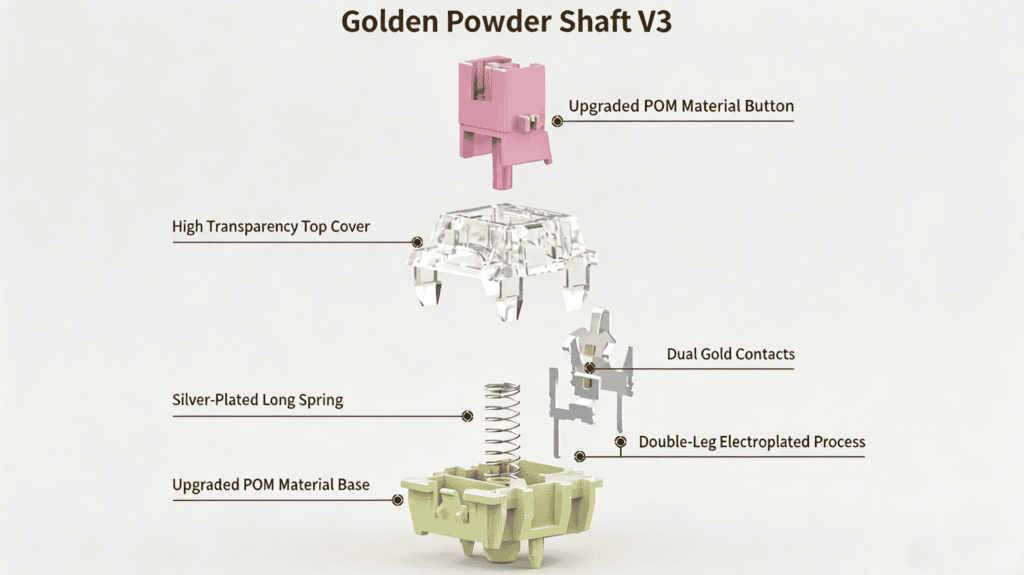
The takeaway here is that no single part creates the feel — it emerges from how these five pieces interact. Now let’s look at the most talked-about one: the spring.
The Feel Formula: How a Spring “Calculates” 37 Grams
The Three Numbers That Define the Switch
Every linear switch lives or dies by three measurements. For the Gold Pink V3, they are:
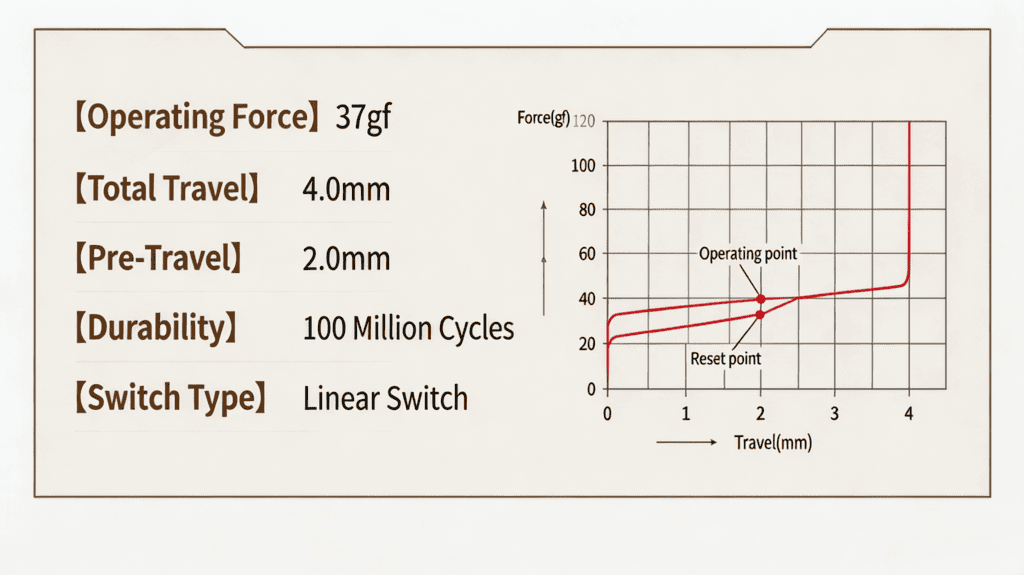
- Actuation force: 37gf (±5gf)
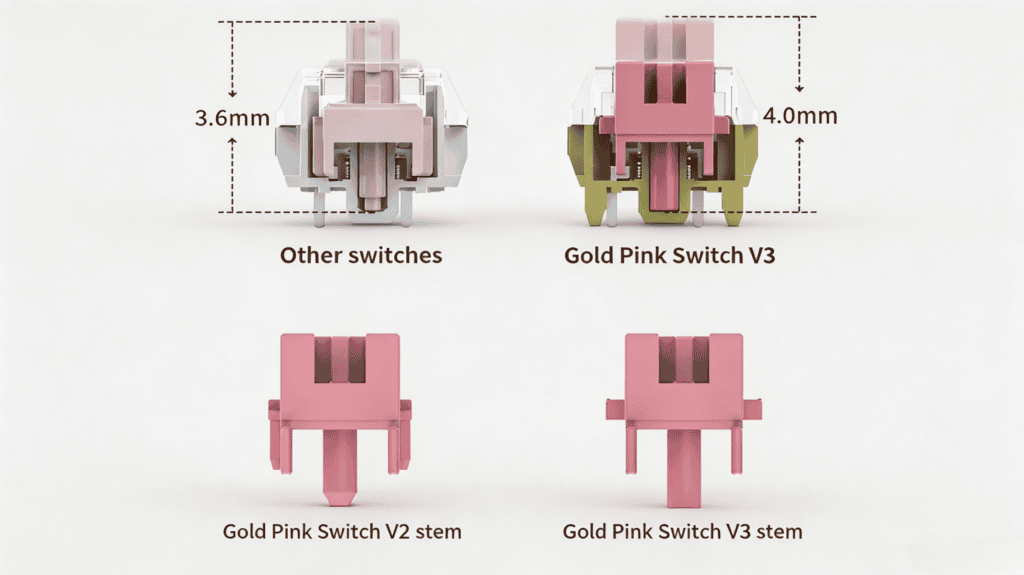
- Actuation travel: 2,0 mm
- Total travel: 4,0 mm
For context, a Cherry MX Red actuates at ~45gf. So what does 37gf actually feel like? Reviewers describe it best: “you only need the natural weight of your fingertip to push it past that 2mm threshold.” That’s the difference between a switch that fights you and one that anticipates you.
The Hidden Strength of the 22mm Long Spring
The V3 uses a 22mm silver-plated long spring, and the length is the whole point.
“37g actuation force, 22mm long. Corrosion-resistant, fatigue-resistant, soft in feel with excellent consistency — the press, travel, and rebound stages feel almost identical.”
Here’s the physics in plain language:
- Short springs: force ramps up fast as you press deeper, so your finger has to work harder near the bottom.
- 22mm long springs: the force curve is flatter and more linear. The deeper you press, the more defined and predictable the rebound push becomes.
This is the physical root of the Gold Pink signature — light, but never mushy or “collapsing.”
A Three-Stage Breakdown of the Keystroke
You can feel the switch in three distinct phases:
- 0 → 2mm (actuation zone): silky, near-zero resistance. The keycap starts sinking the moment your finger lands.
- 2 → 4mm (bottom-out zone): a smooth, controlled descent — a soft-but-solid damping where the POM material earns its keep.
- Return: the long spring releases its stored energy, snapping the keycap back faster than you’d expect. This is where that “connected to your finger” responsiveness comes from.
The V3’s Biggest Secret: The Stem’s “Soft-Elastic” Structure
Detta är den single most important upgrade the V3 brings over the V1 and V2 — and it lives somewhere you can’t easily see.
“The biggest change in the TTC Gold Pink V3 is the stem. The rails on both sides now use a ‘soft-elastic’ structure like the magnetic switch series, reducing the impact contact surface, cushioning shock, lowering rebound vibration, and returning the stem to a flat-bottom design.”
How It Works
“The cushioning soft-elastic structure is cleverly embedded on both sides of the one-piece slider. When the button rebounds and returns, this structure softens the collision as the slider hits the top housing, reducing the noise generated by that impact.”
Varför det spelar roll
- Känsla: the rebound no longer buzzes into your fingertips — the bottom-out gains a bouncy, “Q-elastic” quality.
- Sound: with the flat-bottom stem, the acoustics land better than both V1 and V2 — more focused and solid.
The key insight: the V3 didn’t change the numbers (37gf / 2.0mm / 4.0mm are all identical). Instead, it used structural optimization to lift both comfort and sound quality a full tier. This cushioned bottom-out is exactly what the official Gold Pink V3 listing highlights as its defining trait.
Material Science: The “Self-Lubricating” Magic of POM
What Exactly Is POM?
Both the stem and base housing use upgraded modified POM (polyoxymethylene). In switch design, POM’s superpower is its extremely low friction coefficient och self-lubricating nature. In practice, that means:
- Stays smooth utan heavy grease
- Actually gets smoother with use as the friction surfaces polish themselves
- No sticky, tacky feel in cold environments
The Material “Sound Recipe”
The V3’s material stack is deliberate:
- Top housing: high-clarity PC → excellent light transmission
- Stam: upgraded modified POM → self-lubricating, low friction
- Base housing: upgraded modified POM → focused, concentrated sound
As one review put it: “The base is POM. Combined with the soft-elastic stem design, the sound of the slider hitting the top housing on rebound is noticeably reduced. The overall acoustic sits between V1 and V2 — more focused.”
Factory Lubrication: Ready Out of the Box
The Gold Pink V3 ships with fine, full-travel factory lubrication — and this is not a careless “dab of oil”:
- The stem is pre-lubed at the factory
- The application is delicate — no greasy, over-oiled tackiness
- The full press stays clean and silky, with none of the grittiness, drag, or spring ping you find in cheap switches
Craft Details: The Invisible “Durability Code”
Feel is what you notice on day one. Durability is what you notice on year three. Here’s where the V3 quietly invests.
From Three Pins to Five: The Upgraded Base
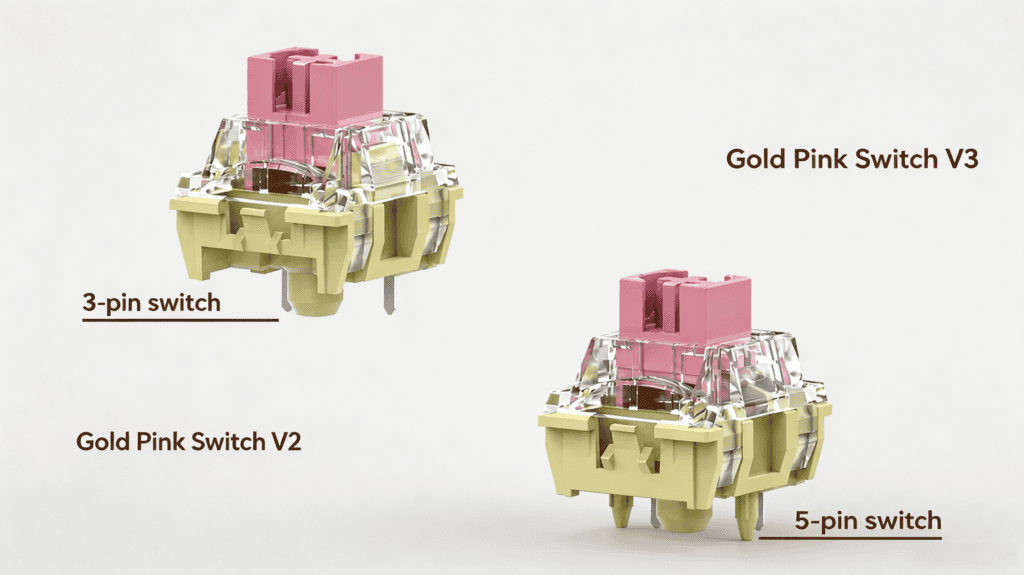
The V2 used a 3-pin base; the V3 moves to a 5-pin base. The practical benefits:
- Greater stability and positioning accuracy on the PCB
- Especially valuable for hot-swappable keyboards — it stays firm after repeated insertions
- Paired with the one-piece dual-sidewall dust-proof slider, it keeps stem travel smoother and more stable
On the product page, this shows up as your ordering choice: the V3 5-pin packs for PCBs that support 5-pin mounting, or V2 3-pin packs for 3-pin plates. Always confirm your socket type before buying.
Dual-Gold Contacts + Silver Plating
The leaf uses a dual-gold contact design, with an anti-oxidation silver plating on the terminal exterior. The value:
- Improved electrical conductivity
- Stronger resistance to tarnishing and oxidation on the terminal legs
- Ideal for hot-swap DIY builders who swap switches often
- A rated lifespan of up to 100 million presses
The Bottom Line: The Engineering Logic of the Gold Pink V3
The Gold Pink V3 didn’t touch the “37g golden formula” that made so many people fall in love — 2.0mm actuation, 4.0mm total travel, 22mm long spring, all unchanged.
Instead, it did the hard work where you can’t see it: the soft-elastic structure on the stem’s sides means the rebound no longer buzzes; the comprehensive use of POM lifts both smoothness and sound quality; the 5-pin base makes every keystroke rock-solid.
Same specs, transformed experience — that’s the truth we uncover once the switch is fully dissected. If you want to feel that engineering for yourself, the TTC Gold Pink V3 switches are available here in 10, 36, 50, and 100-piece packs.

 English
  German
  Portuguese
  Spanish
  Italian
  Finnish
  French
  Japanese
  Korean
  Swedish