
When the MADLIONS TITAN68 Turbo Hall Effect Gaming Keyboard launched, one phrase kept surfacing in official copy and reviews: “dual light position.” It sounds like a headline feature — but the moment you look closer, the term splits into two very different meanings, and the two editions deliver two completely different visual results.
This guide unpacks the whole story: whether the switch itself truly has dual light positions, how the Standard Edition builds its light box, and why the Forged Carbon Edition seems to “hide” its lighting entirely.
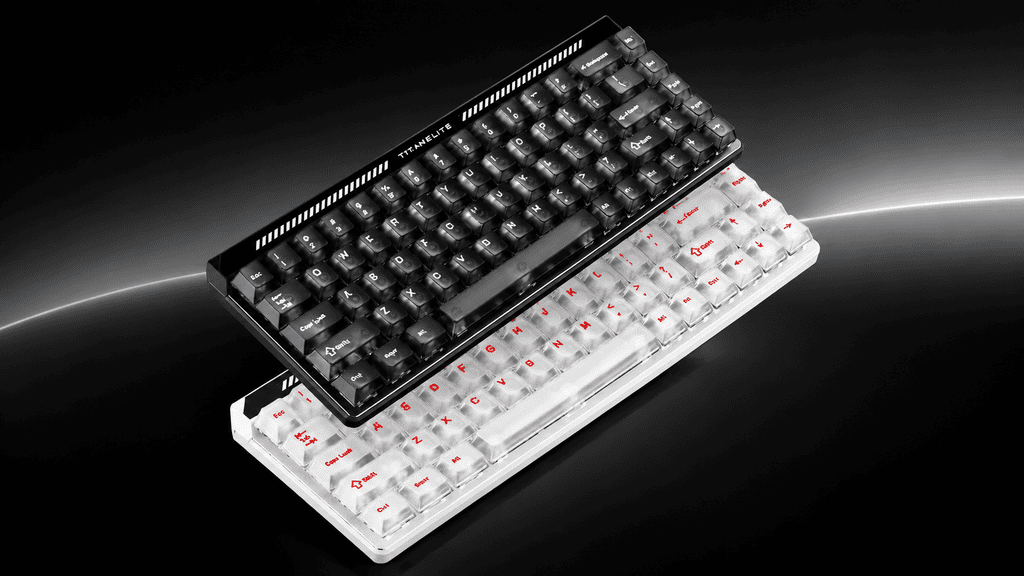
What “Dual Light Position” Actually Means
Before judging whether it’s a genuine upgrade, it helps to separate the concept into two layers — because “dual light position” is doing double duty as both a switch-level und ein keyboard-level term.
Switch Level: The Jade Magnetic Switch’s Light Guide Design
The MADLIONS TITAN68 Turbo runs on the Magnetic Jade Switch, whose housing includes an integrated light guide pillar. Its job is simple but important:
- It channels LED light from the PCB upward toward the keycap.
- This makes illumination more focused and even across each key.
- However, the number and placement of these light guides can vary between switch versions.
Keyboard Level: Light Box vs. Decorative Plate
This is where the two editions diverge sharply:
- Standardausgabe — uses a light box design with RGB pass-through and low-power, high-brightness LEDs. The light effect is clearly visible.
- Forged Carbon Edition — the top is covered by a forged carbon decorative plate, so light can’t shine directly through. You only catch a faint glow through the frosted semi-transparent material on the rear.
Wichtigste Erkenntnis: “Dual light position” is best understood as a platform-level capability — but how much each edition releases that capability is entirely different.
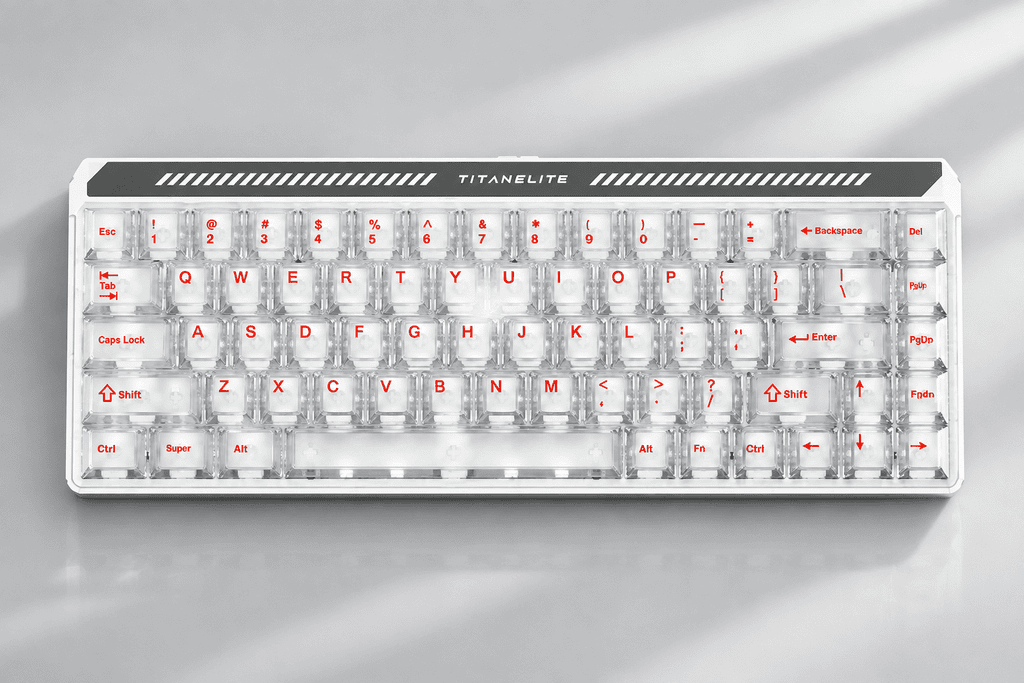
Standard Edition: The Light Box and Full Light Release
The Standard Edition is where the lighting story reaches its fullest expression. Think of it as the “light-show version” of the MADLIONS TITAN68 Turbo.
How the Light Box Is Built
At the top of the keyboard sits a dedicated light box module. RGB LEDs scatter their light outward through this box:
- Low-power, high-brightness LEDs keep the glow bright without draining efficiency.
- Der size and position of the light box define the visible display area — and here it’s fully exposed and viewable.
How It Looks in Use
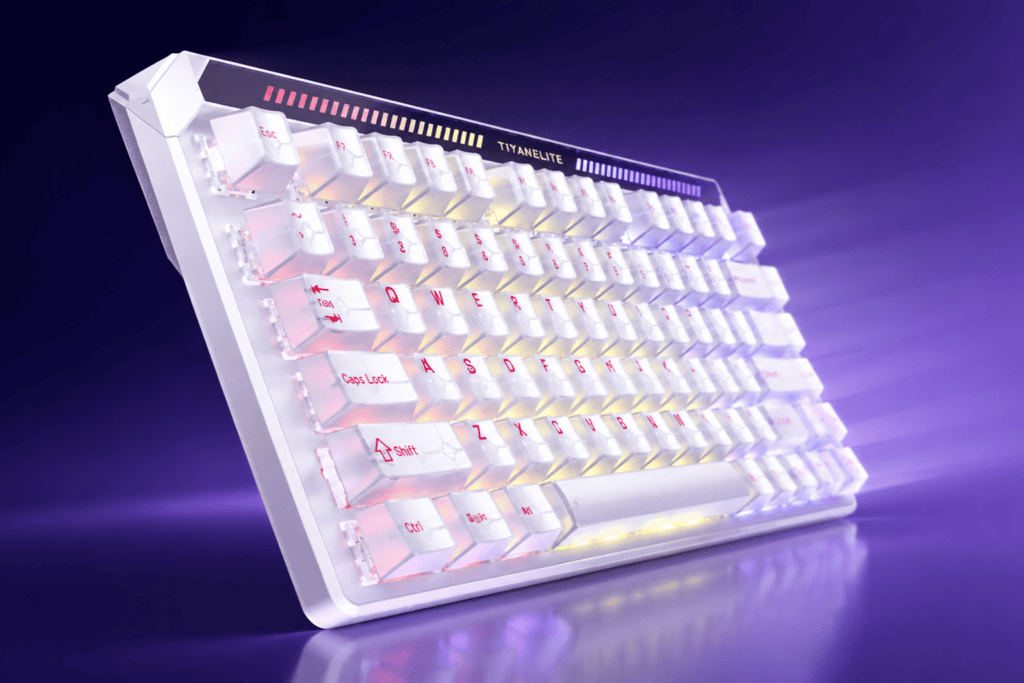
- Front view: the light box forms a continuous ribbon of light with smooth RGB transitions.
- Side view: a slight height difference lets light spill out in layers.
- Paired with the black translucent frosted keycaps, even the gaps between keys glow with an even backlight ambiance.
Who Should Choose the Standard Edition
- Users who treat the keyboard as a desktop ambient light.
- Gamers who play in dim environments and want visual immersion.
- Anyone who prioritizes complete light effects over a carbon-fiber texture.
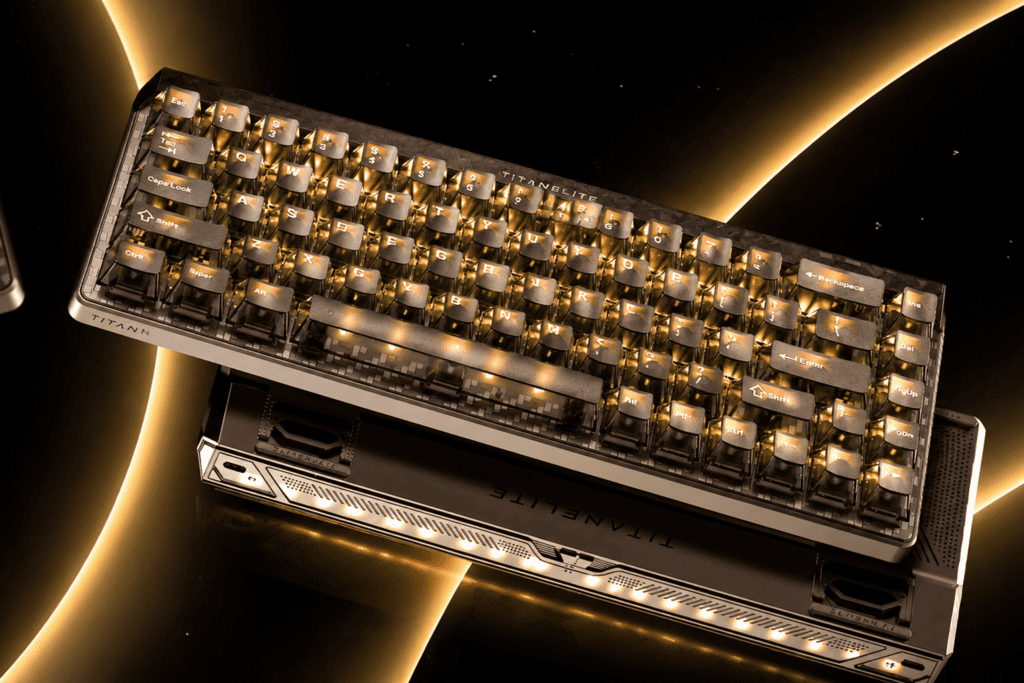
Forged Carbon Edition: Restrained Aesthetics Beneath the Plate
The Forged Carbon Edition takes the opposite philosophy — it’s the “restrained texture version,” where visual material quality outranks RGB spectacle.
What the Forged Carbon Armor Is
A forged carbon-pattern decorative plate — made from carbon-fiber composite — covers the top of the keyboard. Its purpose is elevating tactile and visual quality: the forged-carbon texture carries a premium, sporty character. But it also physically blocks the light box, so top-side lighting can’t shine through directly.
Where Did the Light Go?
The light didn’t disappear — the LEDs are still glowing:
- The carbon plate simply blocks direct front-facing light.
- Der only light exit is the frosted semi-transparent material on the rear, producing a soft ambient halo from below.
Defect or Deliberate Design?
- From a light-effect standpoint: yes, the Forged Carbon Edition’s lighting is weaker than the Standard’s.
- From a design-logic standpoint: the edition is positioned as texture-first — the visual value of carbon fiber outweighs RGB flair.
This is intentional restraint, not a failure to execute lighting well.
Who Should Choose the Forged Carbon Edition
- Users who see the keyboard as a desktop texture piece, not a light display.
- Fans of carbon-fiber grain and understated premium aesthetics.
- Those who mostly work in bright environments and rely little on RGB.
Core Difference Comparison: One Table to See It Clearly
Here’s a side-by-side look at how the two editions diverge — and where they stay identical.
| Dimension | Standardausgabe | Forged Carbon Edition |
|---|---|---|
| Top Lighting | Light box design, direct RGB pass-through, clearly visible | Blocked by carbon plate, no direct top-side light |
| Rear Lighting | Not emphasized | Frosted semi-transparent — faint LED glow visible |
| Schalten | Magnetic RGB switch | Magnetic Jade Switch (with light guide) |
| Plattenmaterial | Standard plate | 3K-pattern carbon-fiber plate |
| Aesthetic | Transparent, esports-leaning | Carbon-fiber grain, sporty/premium-leaning |
| Shared Specs | Dual 288MHz MCU · GaAs Hall sensors · 0.08ms latency · 0.001mm RT precision · 8K polling rate · dual Type-C | Same as left |
Wegbringen: the performance core is identical — the choice comes down purely to whether you want light or texture on top.
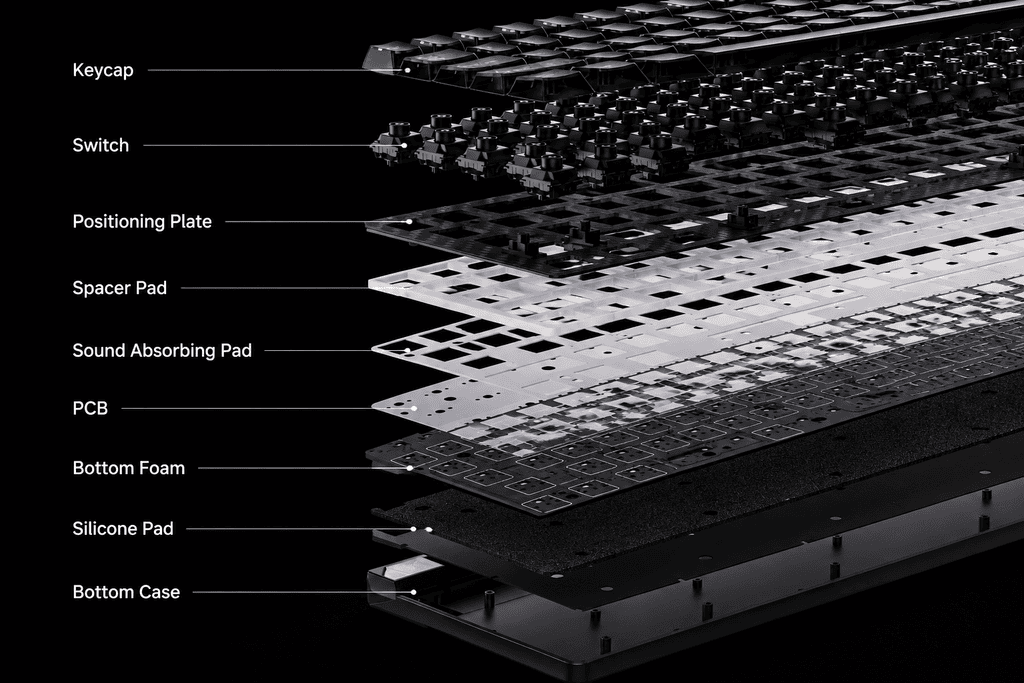
Teardown Verification: The Lighting System Inside
To confirm whether “dual light position” is real engineering or clever wording, it helps to open the keyboard up.
The Teardown Process
- Removing 10 screws opens the keyboard; the forehead section is held by plastic clips — easy, damage-free disassembly.
- Inside, you can clearly see the LED layout on the PCB.
Inside the Light Box Module
- The Standard Edition’s light box is a standalone structural part at the top, aligned with the PCB LEDs.
- It likely contains a diffuser or light-guiding material to spread illumination evenly.
How the Carbon Plate Mounts
- The forged carbon plate is fixed via clips or screws at the top.
- Remove it, and the LEDs are still visible — but in normal use, the plate covers the light’s exit.
- Notable detail: the Jade Switch has its own light guide pillar, but in the Forged Carbon Edition, that guiding effect is weakened by the plate above it.
The PCB-Level “Dual Light Position”
- The MADLIONS TITAN68 Turbo uses a four-layer PCB with fully wrapped, interference-resistant traces.
- The LED layout may support upper and lower dual light positions — but the real-world effect depends entirely on the light box or plate structure sitting above it.
Buying Advice: Which Edition Is Right for You?
Both editions share the same elite Hall-effect performance, so your decision is about aesthetic intent, not capability.
Choose the Standard Edition if…
- You value RGB and want immersive lighting in dim settings.
- You prefer a transparent, bright visual style.
- Complete light expression matters more to you than carbon texture.
Choose the Forged Carbon Edition if…
- You want the premium feel of carbon-fiber grain and accept partly hidden lighting.
- You mainly use the keyboard in bright environments with low RGB reliance.
- You appreciate restrained, understated design — where “invisible light” is its own statement.
One Key Reminder
“Dual light position” is not a unified experience on the MADLIONS TITAN68 Turbo — it’s a visual selling point on the Standard Edition and a deliberately restrained function on the Forged Carbon Edition. Confirm which version you’re buying, and how much lighting truly matters to you, before you check out on the official MADLIONS TITAN68 Turbo product page.
Conclusion: Lighting Isn’t Everything, But the Choice Must Be Clear
The MADLIONS TITAN68 Turbo’s “dual light position” design produces two entirely different visual outcomes:
- Der Standardausgabe ist die light-show version — the light box glows, and RGB is fully released.
- Der Forged Carbon Edition ist die restrained-texture version — the plate conceals the light, and carbon-fiber grain takes center stage.
This isn’t a question of better or worse. It’s two editions serving two different aesthetic philosophies. Understand the lighting difference clearly, and you’ll make a choice you won’t regret.


 English
  German
  Portuguese
  Spanish
  Italian
  Finnish
  French
  Japanese
  Korean
  Swedish